A temporary stage can look simple: a platform, some legs, a few locking mechanisms and a performance waiting to begin. But underneath the surface, it is a structural system that has to support people, equipment and activity safely.
For schools, churches, community halls, venues and event organisers, temporary stage safety should never be based on guesswork. A stage needs to be suitable for its intended use, correctly assembled and operated within its specified limitations.
HSE guidance for temporary demountable structures recommends considering stability, structural integrity, foreseeable risks and the effects of dynamic loading when designing and managing temporary structures.
So, before your next event, make sure you aren’t making one of these five common mistakes.
1. Guessing the Stage Load Capacity
One of the easiest mistakes to make is assuming that a stage is strong enough simply because it looks sturdy.
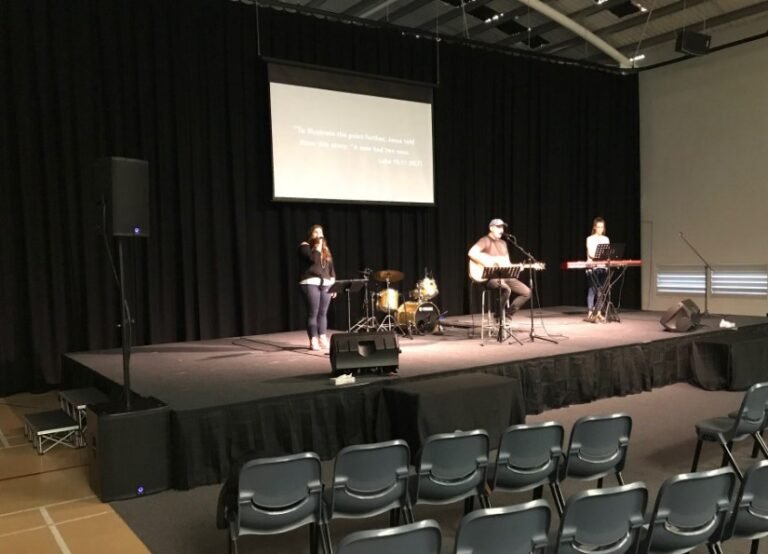
A school choir, for example, might put dozens of children, teachers, instruments and equipment on the same platform. A corporate event might add speakers, screens, furniture and presentation equipment.
The important question isn’t simply, “How much does everything weigh?”
You also need to consider how that weight is distributed.
A load spread evenly across a platform is different from a heavy piano, speaker cabinet or piece of scenery concentrated on a small number of contact points. Movement can also create dynamic effects that need to be considered in the stage’s design and permitted use.
Before installation, check the manufacturer’s stated:
- Maximum distributed load
- Point-load limitations
- Approved configurations
- Span and support requirements
- Intended use
- Restrictions on movement or equipment
Never assume that two stages of the same size have the same stage load capacity.
If the planned use falls outside the manufacturer’s documented limitations, seek appropriate professional advice rather than attempting to calculate a new safe limit yourself.
2. Choosing Cheap or Unsuitable Staging
Price matters, but choosing temporary staging based solely on the lowest price can create problems later. A stage should be selected according to its intended application, not simply its appearance or dimensions.
Before buying or hiring a system, ask the supplier for relevant technical information, including:
- Product specifications
- Load ratings
- Assembly instructions
- Approved configurations
- Inspection and maintenance requirements
- Applicable standards or test documentation
- Indoor or outdoor-use limitations
For temporary event structures, HSE guidance recommends that risks associated with construction, use and deconstruction are properly assessed and that the design considers stability and structural integrity.
In the UK, safety isn’t a suggestion—it’s a legal requirement. If you are using a stage in a public space, it must adhere to specific portable stage regulations in the UK. Using uncertified gear doesn’t just risk a collapse; it voids your public liability insurance. If an accident happens on a non-compliant stage, the insurer will walk away, leaving you to face the legal fallout alone.
There is also an important distinction between having a particular certificate and actually being suitable for a specific application. Don’t assume that the absence of one particular certification automatically means a stage is illegal—or that possessing a certificate automatically makes every installation safe.
The correct approach is to establish which requirements and standards apply to the particular product and event.
3. Ignoring Fire Safety Around Stage Skirting and Drapes
Structural stability isn’t the only part of temporary stage safety.
Temporary stages often use skirting, drapes, scenery, banners and other decorative materials. These materials can contribute to fire development if they are unsuitable or poorly managed.
UK government fire-safety guidance for places of assembly specifically identifies curtains, drapes, scenery and banners among materials that should be considered in a fire-risk assessment. It recommends using suitable fire-retardant materials where appropriate and following manufacturers’ instructions for maintaining fire-retardant treatments.
Don’t assume that every piece of black stage fabric is automatically fire-safe.
Before using stage skirting or drapes, check:
- The material’s fire-performance information
- Whether treatment is durable or requires maintenance
- Whether documentation is available from the supplier
- Whether the material is suitable for the venue
- Whether fabrics are positioned safely around lighting and other heat sources
Always ensure you are using certified fire retardant stage skirting. A few extra pounds spent on IFR (Inherently Flame Retardant) fabric is a tiny price to pay to prevent a catastrophe.
Electrical cables should also be routed and protected appropriately so they don’t create trip, damage or ignition hazards.
If your event includes specialist lighting, pyrotechnics or other heat-producing equipment, additional controls may be required.
4. Setting Up on an Unsuitable or Uneven Surface
A perfectly assembled stage can still become unsafe if it is installed on an unsuitable surface. Before setting up, inspect the floor or ground carefully.
For indoor venues, look for:
- Uneven flooring
- Damaged floor surfaces
- Unexpected slopes
- Areas with inadequate support
- Obstacles or debris
For outdoor events, additional issues may include:
- Soft ground
- Poor drainage
- Uneven terrain
- Ground bearing capacity
- Wind exposure
- Anchoring requirements
- Weather conditions
HSE event guidance highlights ground conditions, load-bearing capacity, anchoring, extreme weather and wind loading as important considerations when positioning temporary structures.
Do not improvise with random pieces of timber, packing materials or homemade supports.
Instead, use the levelling and support method specified by the manufacturer. If the manufacturer’s instructions do not provide a suitable solution for the actual site, obtain competent advice before proceeding.
For larger or more complex temporary structures, site-specific engineering assessment may be appropriate.
5. Rushing the Final Inspection
When an event is starting in 20 minutes and guests are already arriving, it can be tempting to rush the final checks. That’s exactly when a disciplined process matters most.
The stage should be assembled according to the manufacturer’s instructions, with appropriate personnel carrying out the installation. HSE guidance places emphasis on competent planning and appropriate arrangements for temporary structures.
Before allowing performers or members of the public onto the stage, check:
Structure
- Are all components correctly positioned?
- Are all required connections properly engaged?
- Are supports installed as specified?
- Is the stage stable?
Decking
- Are all deck panels correctly fitted?
- Are there gaps, damaged panels or loose sections?
- Is the surface suitable for the intended activity?
Load
- Does the planned use remain within the manufacturer’s stated limitations?
- Are heavy items positioned according to the supplier’s requirements?
- Are point-load restrictions being observed?
Site
- Is the supporting floor or ground suitable?
- Are access routes clear?
- Are trip hazards controlled?
- Are exits and emergency routes unobstructed?
Environment
- If outdoors, have weather and wind conditions been considered?
- Are required anchoring or ballast arrangements in place?
Fire and electrical safety
- Are stage fabrics and scenery suitable?
- Are electrical cables safely routed?
- Are heat-producing lights and other equipment appropriately positioned?
If anything appears damaged, unstable or outside the manufacturer’s specified configuration, stop and investigate before the stage is used.
Why Temporary Stage Safety Requires More Than a Visual Check
A stage may look stable while important structural or installation issues remain hidden. That is why temporary stage safety should be approached as a process rather than a single inspection.
HSE’s model guidance for temporary demountable structures recommends assessing risks associated with construction, use and deconstruction, while the design should consider stability, structural integrity and likely dynamic loading.
Recent HSE enforcement also demonstrates why temporary structures must be properly designed and managed. In a 2026 case involving a temporary platform collapse, HSE reported that no design or safe-loading calculation had been made and emphasised that temporary structures must withstand foreseeable loads and be used only for their designed purpose.
The lesson is straightforward: don’t guess, improvise or exceed the documented limitations of the structure.
Temporary Stage Safety Checklist
Before your next event, use this quick checklist:
- Check the manufacturer’s specifications.
- Confirm the permitted load capacity.
- Consider point loads as well as distributed loads.
- Follow the approved stage configuration.
- Use the specified assembly method.
- Check the floor or ground before installation.
- Consider wind and weather for outdoor events.
- Use suitable fire-performance materials.
- Keep electrical equipment and cables properly managed.
- Inspect the completed stage before use.
- Keep emergency exits and access routes clear.
- Stop and seek competent advice if something doesn’t look right.
Don’t Leave Temporary Stage Safety to Chance
The biggest enemy of safety is the ticking clock. When the event starts in 30 minutes, it’s tempting to skip the final check of the locking pins or ignore a slightly “wobbly” leg.
A stage is only as safe as its weakest lock. We recommend a “Two-Person Sign-Off” protocol: one person assembles the stage, and a second, independent person physically checks every single lock and bolt. If it doesn’t feel rock-solid, it isn’t ready.
Final Thoughts
The biggest risks in temporary staging often come from simple assumptions: assuming the stage can carry more than its stated capacity, assuming every surface is suitable, assuming stage fabrics are automatically fire-safe or assuming a quick visual check is enough.
Good temporary stage safety starts with selecting an appropriate system and continues through planning, installation, inspection and responsible use.
The goal of every event is to create a memory for the audience. Don’t let that memory be a safety failure. Be rigorous, be documented, and above all, be safe.
Related reading:
The Evolution of Portable Stages
Tiered Stage Boxes for Choir Performances UK
7 Creative Event Stage Design Ideas
NexGen Portable Stage Systems UK
About The Author